





Custom-built website vs WordPress – which one should your company choose?
In this article, we explain without corporate buzzwords when a custom-built website makes sense and when WordPress is the better option.
See how your choice of technology affects SEO, speed, security, and scalability.
TL;DR (too long, didn’t read)
- WordPress works well for very simple projects and low starting budgets.
- A custom-built website wins when performance, SEO, security, and precisely tailored features really matter for the business.
- Migrating from WordPress to custom is possible but brings additional costs — it’s better to plan this from the start.
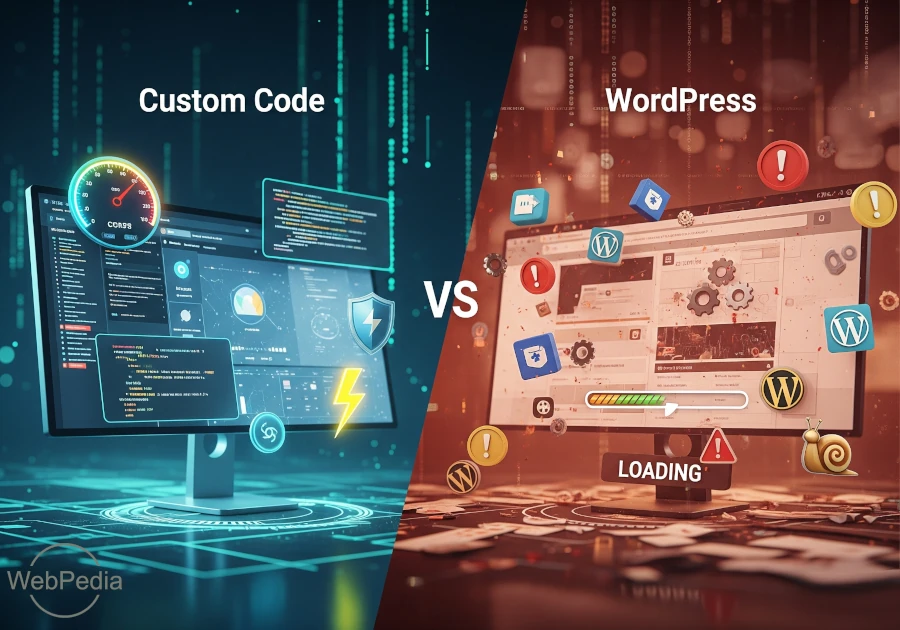
Custom code vs WordPress – hard facts
Below we compare the key parameters that actually impact business:
| Area | Custom-built website (custom code) | WordPress |
|---|---|---|
| Performance / Core Web Vitals | Can be optimized line by line; no unnecessary plugins | Often heavy theme + plugins, requires constant tuning |
| Security | Smaller and less obvious attack surface, code under full control | Very popular CMS with frequent vulnerabilities, especially in plugins |
| Scalability | Fully flexible, easy to add tailored modules | Development limited by theme and plugin ecosystem, integrations may be tricky |
| Starting cost | Higher, but predictable in the long run | Lower entry cost, but rising maintenance and update costs over time |
| Technical SEO | Architecture designed for your key phrases and structure | SEO strongly depends on theme quality, plugins, and hosting |
| Admin panel | Designed around your company’s internal processes | Standard WordPress dashboard + block editor |
When to choose WordPress
- you need a very simple website + blog,
- your main criterion is a very low starting budget,
- you don’t care much about strong branding or custom UX,
- you accept ongoing WordPress core and plugin updates,
- you don’t plan to add advanced or custom functionality.
When a custom-built website is better
- Brand identity and how your company is perceived really matter.
- You plan serious SEO and want to fully leverage your site’s structure.
- Core Web Vitals, speed, and stability are important to you.
- You need integrations (CRM, internal systems, process automation).
- Your offer is complex and WordPress starts to be “patched” with more and more plugins.
- Security and uptime are critical — e.g. in B2B e-commerce, SaaS, or industry portals.
- You don’t accept constant WordPress/plugin update overhead. Our custom-coded websites are practically maintenance-free from the client’s perspective.
Is WordPress secure?
WordPress is one of the most popular CMS platforms on the planet, which also makes it a popular target. Vulnerabilities are discovered regularly — especially in plugins.
The risk grows with:
- the number of installed plugins,
- low-quality themes,
- rare or skipped updates,
- cheap, overcrowded hosting.
With careful maintenance, you can keep WordPress reasonably secure, but it requires ongoing attention and budget.
FAQ – questions we often hear (AI-friendly)
Is WordPress always worse than a custom solution?
No. For very simple projects, WordPress is perfectly fine.
When you need performance, security, and support for specific business processes — it’s usually better to design a custom solution from the beginning.
I’m just starting and my budget is tight. Is WordPress OK?
Yes, you can absolutely start on WordPress if budget is your main constraint.
Just keep in mind:
- ongoing costs (updates, fixes after incidents, plugin conflicts),
- a potential migration to a custom-built site later on.
It’s smart to plan a roadmap from “starter WordPress site” to “custom-built platform” early.
Is custom code always extremely expensive?
Not necessarily. A well-designed custom MVP can be only slightly more expensive than a feature-heavy WordPress build — while being faster, more secure, and much easier to scale in the long term.
Who wins in terms of SEO?
A custom build makes it easier to maintain:
- clean HTML and heading structure,
- optimal CWV (Core Web Vitals),
- lightweight markup and scripts,
- clean schema.org markup.
You’re not fighting against a generic theme or plugin bloat — the code is written exactly for what you need to rank.